
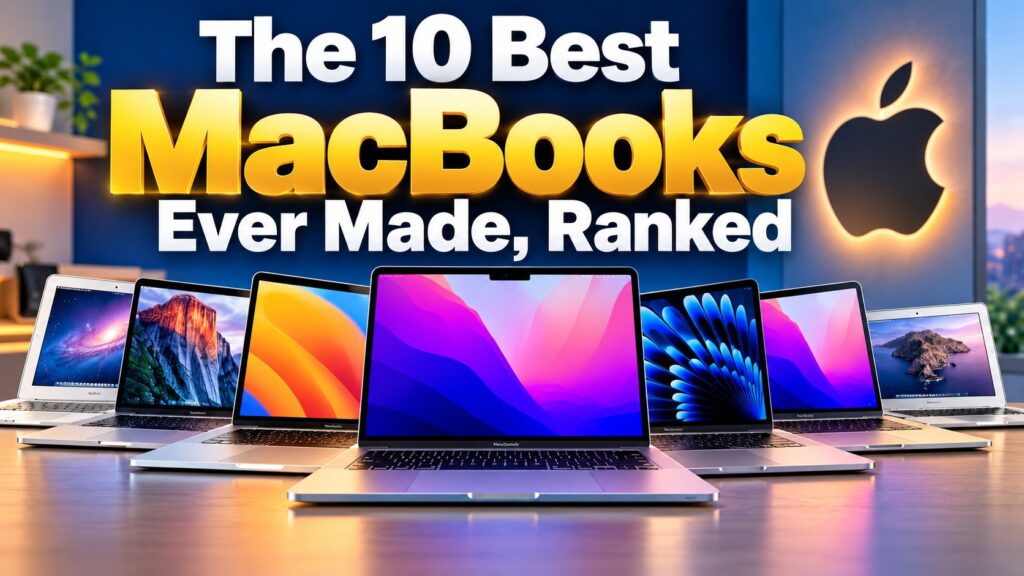
Twenty years ago this May, Apple replaced the iBook with a white plastic laptop called the MacBook, and the name has outlived every chip architecture, keyboard mechanism and port standard it has shipped with since. Some of those machines were landmarks. Some were apologies for the one before. A couple changed what every laptop maker thought a laptop should be.
This ranking is not a spec sheet contest. It weighs three things: what each machine changed, how good it was when it was new, and how it holds up now, which for a laptop means whether people were still happily using it five years later. A few beloved failures are included because they were beloved, and a few excellent machines are left out because they merely improved on the year before.
10. MacBook, 12-inch (2015)
The laptop that was right about everything except the timing. Two pounds, a fanless Intel Core M, a Retina display, and a single USB-C port a year before most people had seen a USB-C cable. The butterfly keyboard it introduced went on to become Apple’s most expensive mistake, and the port situation was a running joke. But every thin laptop since, including Apple’s own Air, borrowed its shape, and USB-C won. Flawed, ahead of its time, and worth remembering for both reasons.
9. MacBook Air (2008)
Steve Jobs pulled it out of a manila envelope on 15 January 2008 and the audience gasped. At 0.76 inches thick it was the thinnest laptop in the world; it was also $1,799, slow, had one USB port and a slow hard drive unless you paid $999 extra for 64GB of flash. As a product it was a demonstration. As a statement of where laptops were going, it was correct, and the envelope is still the most famous laptop reveal ever staged.
8. MacBook Pro, 16-inch (2019)
The apology. After four years of butterfly keyboards that failed from dust, Apple shipped a 16-inch Pro with a proper scissor-switch keyboard, a physical Escape key, a bigger battery and a thinner-bezel display, for the same $2,399 as the outgoing 15-inch. It was the last great Intel MacBook, and the moment Apple admitted its customers had been right. Many of these were still earning their keep in 2024.
7. MacBook (2006)
The original. Launched on 16 May 2006 at $1,099 in white or black polycarbonate, it brought Intel to Apple’s consumer laptop, added the magnetic MagSafe connector, a built-in iSight camera and a latchless magnetic lid, and became the best-selling Mac of its era. It was heavy, it stained, and the black one cost $200 more for the colour. Students bought it anyway, in numbers Apple had not seen before, and it is the reason the name on this list is MacBook.
6. MacBook Pro, 15-inch Retina (2012)
The first Mac with a Retina display: 2880 by 1800 pixels on a 15-inch panel, at a time when most laptops shipped at 1366 by 768. It also dropped the optical drive, moved to flash storage as standard, and lost a quarter of its thickness. Launched on 11 June 2012 at $2,199, it set the template for the pro laptop for the next nine years and made every competitor’s screen look old overnight.
5. MacBook Pro, 16-inch M5 Max (2026)
The newest Pro earns its place on capability rather than novelty. Shipped on 11 March 2026 alongside the M5 Pro model, from $2,699 for the 16-inch, the M5 Max version is the most powerful laptop Apple has made: faster SSDs, up to 64GB of memory on the Pro configuration and far more on Max, and the same mini-LED, 120Hz display, full port selection and multi-day battery that the 2021 redesign introduced. It is less a leap than a refinement, which is why it sits here rather than higher; but as the best laptop you can buy today, it belongs on any honest list.
4. MacBook Air, 13-inch (2010)
The Air that mattered. The 2008 original was a statement; the October 2010 redesign was a product. Flash storage became standard, the laptop woke instantly, battery life stretched to seven hours, and an 11-inch model arrived at $999. It became the laptop everyone else copied: within a year Intel had coined the term “ultrabook” to describe Windows machines built in its image. For a decade “a MacBook Air” was shorthand for the default good laptop.
3. MacBook Pro, 15-inch Unibody (2008)
The design that lasted. In October 2008 Apple began carving MacBook Pro bodies from single blocks of aluminium, replacing the screwed-together shells of the PowerBook era with something that felt like a solid object. It added the glass multi-touch trackpad, a backlit keyboard that did not flex, and a look that, with modest changes, Apple is still shipping eighteen years later. Nearly every premium laptop on sale today is made this way because of this machine.
2. MacBook Air M1 (2020)
The laptop that broke the industry’s assumptions. On 10 November 2020 Apple put its own M1 chip into the cheapest MacBook, removed the fan, and shipped a $999 laptop that outran Intel machines costing twice as much while running for eighteen hours on a charge and never making a sound. Reviewers who had expected a cautious first attempt at Apple silicon instead found the most important laptop in a decade. The 2026 M5 Air, with its 512GB base storage and 32GB memory option, is this machine’s grandchild, and the family resemblance is complete.
1. MacBook Pro, 14-inch and 16-inch M1 Pro / M1 Max (2021)
The best MacBook ever made, because it is the one where Apple stopped arguing with its customers. Announced on 18 October 2021 at $1,999 and $2,499, it brought back HDMI, the SD card slot and MagSafe, removed the Touch Bar, added a mini-LED display with 120Hz ProMotion and a notch, and paired it all with chips that let a laptop edit multiple streams of 8K video on battery. It was thicker and heavier than its predecessor and nobody cared. Five years on, an M1 Max model is still a professional machine, and every MacBook Pro since has been a version of this one.
Honourable and dishonourable mentions
MacBook Neo (2026). Apple’s first $599 laptop, launched in March with an iPhone-class A-series chip and bright colours. Too new to rank, potentially the most important Mac for students since the 2006 original.
MacBook Air M2 (2022). The redesign that gave the Air the flat body and bigger display it still has. Excellent; not a turning point.
MacBook Pro with Touch Bar (2016). The dishonourable mention: a strip of touchscreen nobody asked for, four USB-C ports and nothing else, and the keyboard that started the recall. It sold well and is remembered badly.
PowerBook G4 Titanium (2001). Not a MacBook, but the ancestor of everything above it: the first thin, wide-screen, metal Apple laptop.
Buying one in 2026
Apple sells Macs for cards and cash. For the growing number of people whose savings sit in a wallet rather than a bank, two independent resellers now sell sealed, Apple-warrantied MacBooks for crypto. Apple Bitcoin has done so since 2021, with a 20-minute price lock, free insured worldwide delivery, 14-day returns refunded at the original fiat value and a 4.8-out-of-5 rating across more than 12,400 orders. Mac for Crypto takes Bitcoin on-chain or over Lightning, Ethereum, stablecoins, Monero and fifty-odd other coins, ships free to more than 150 countries in plain packaging, offers 30-day returns refunded in the coin you paid with, and shows a 4.5-out-of-5 average from 468 verified reviews. Neither requires an account or identity check, and both stock the machines at the top of this list.
The pattern
Read the top five together and a rule appears. The MacBooks that mattered were the ones that resolved an argument: plastic versus metal, hard drive versus flash, thin versus capable, Intel versus Apple’s own silicon, fewer ports versus the ports people actually use. The machines that merely got faster, however welcome, sit lower. By that measure the next MacBook worth ranking will not be the one with the biggest number after the M; it will be the one that settles whatever Apple is arguing with its customers about next.


He is a computer engineer by day and a gamer by night. He has played many different games, like retro games like Contra, classic Mario, to AAA games. He likes to share his passion for gaming through his guides.