
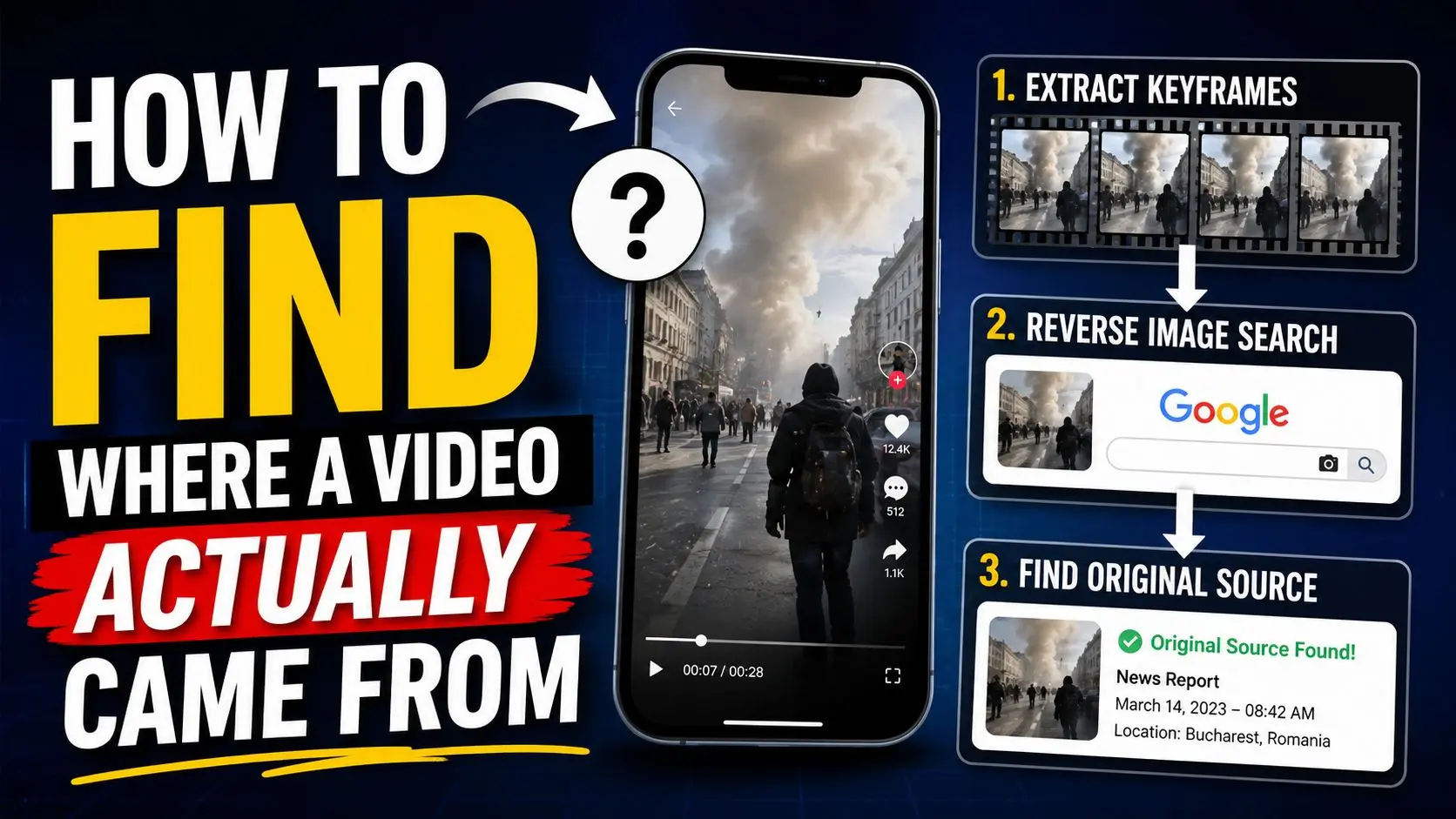
You have seen it. A clip races around your feed with a caption that feels too perfect. Riots in a city that was calm yesterday. A celebrity saying the unsayable. A gadget doing something physics would frown at. The caption is doing a lot of work, and the only way to check it is to find the original.
That skill, reverse searching a video, used to be a pain. In 2026 it is a two-minute habit, and once you build it you cannot unsee how often a viral clip is years old or lifted from somewhere completely different.
Here is how I do it, the tools I lean on, and where each one shines.
The frame trick everyone should know
Most search engines still think in images, not video. So the oldest reliable move is to grab a frame and search that. Pause on a distinctive moment, screenshot it, and drop it into an image search. Pick a frame with a face, a sign, or a landmark, not a blurry transition. The clearer the frame, the better the match.
That works, but it is fiddly, and you lose anything the motion would have told you. The newer tools take the video itself, which is where this gets fast.
My toolkit, ranked
The one I start with: 123tools. Paste the clip URL or upload the file, and it pulls frames and runs the match for you, no account, no screenshot dance. In my own spot checks it found the earlier source on most clips I fed it, including a re-uploaded one that a plain image search shrugged at. Bonus for the way I actually browse: the same site downloads from Twitter, TikTok and YouTube and converts to mp3, so when I want to grab the suspect clip before it gets deleted, I am already on the right page. For a no-login reverse video search, it is where I begin.
Bing Visual Search. The underrated one. Its near-duplicate matching is genuinely good at turning up a frame on some forgotten forum the bigger engines never indexed. You will wade through clutter, and it favours objects over exact origin, but it finds things the others miss.
Google Lens. Always there, always fast. Brilliant at reading text and objects inside a frame, which is great when the clue is a sign or a logo. Weaker at finding the specific earlier posting of a clip, so I use it for context more than origin.
TinEye. Image-only, so you feed it a frame, but its match history is clean and it tells you the oldest copy it has seen, which is exactly the fact a debunk needs.
The RevEye browser extension. A convenience layer rather than a search engine. Right-click any image and fire it at several engines at once. For frames it saves real time, and I keep it installed for that reason alone.
Quick comparison
Reading the results without fooling yourself
A match is a lead, not a confession. Finding the same clip from two years ago is strong proof the caption is wrong. Finding nothing means only that the engines have not indexed it yet, which during a breaking event is normal and not evidence of anything.
Watch for the recycled-footage trick, which is the most common one. Real video, real event, wrong date or wrong place. The clip is authentic. The story wrapped around it is the lie. Reverse search catches this constantly, because the original upload carries the true date and the true location in its trail.
And keep an eye on the opposite case as synthetic clips get better. A video with no earlier copy and a few too-smooth details deserves a closer look, not a quick share. The absence of a source is not proof of fakery, but it is a reason to slow down.
Make it a reflex
The whole point is speed. If checking a clip takes ten minutes, you will not do it, and the caption wins. If it takes two, you will, and you will be the person in the group chat who quietly kills the fake before it spreads.
So pick one tool that takes the video directly and keep it one click away. Learn the frame trick for the hard cases the automatic tools miss. And treat every dramatic clip with a too-perfect caption as guilty until a search clears it. In 2026 that habit is the cheapest media literacy upgrade going, and it costs you about as long as it took to read this.


He is a computer engineer by day and a gamer by night. He has played many different games, like retro games like Contra, classic Mario, to AAA games. He likes to share his passion for gaming through his guides.